

Identity & FICA
FICA files that hold up when the FIC asks.
Send one secure link. Verify SA ID holders against Home Affairs and companies against CIPC, screen for sanctions and politically exposed persons, and keep a client file ready for whenever the FIC asks.
South Africa only, for now
If you are an accountable institution, this is not optional.
The Financial Intelligence Centre Act requires accountable institutions to establish and verify who their clients are before acting for them, to keep the records, and to screen against sanctions and politically exposed person lists.
- Property practitioners and estate agents
- Attorneys
- Trust and company service providers
- High-value goods dealers
- Credit providers
Built for and live with property practitioners today. The module is not property-specific. If you are another accountable institution, contact us.
The file matters as much as the deal.
- An FIC or PPRA inspection expects immediate access to your client due-diligence files, source-of-funds checks, beneficial-ownership verification, and evidence of sanctions and PEP screening.
- Without a valid Fidelity Fund Certificate a property practitioner may not render services, or be paid.
- Most published sanctions came from paperwork failures rather than wrongdoing: compliance that existed only on paper.
- And in the meantime, someone is chasing ID copies over WhatsApp, filing them by hand, and holding up a deal until the documents land.
Send one link. Get back an audit-ready client file, verified as deeply as you chose to check.
Checks that follow the risk
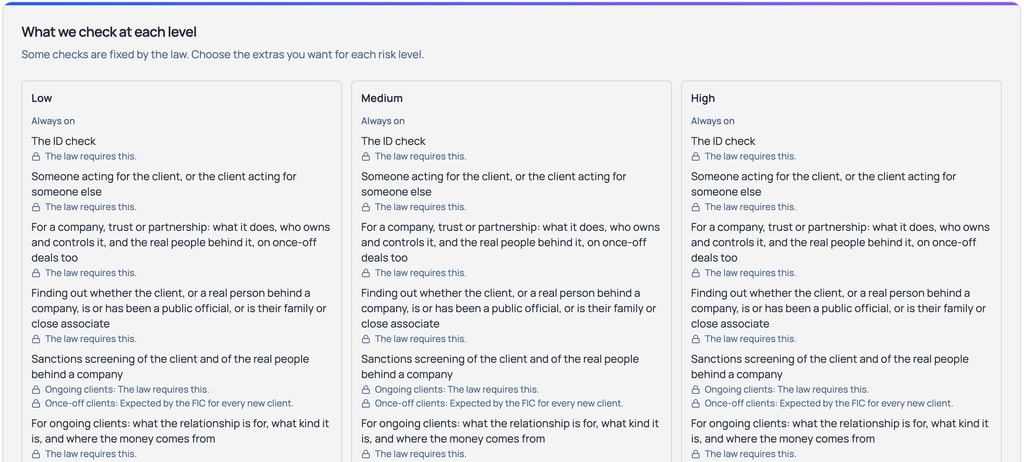
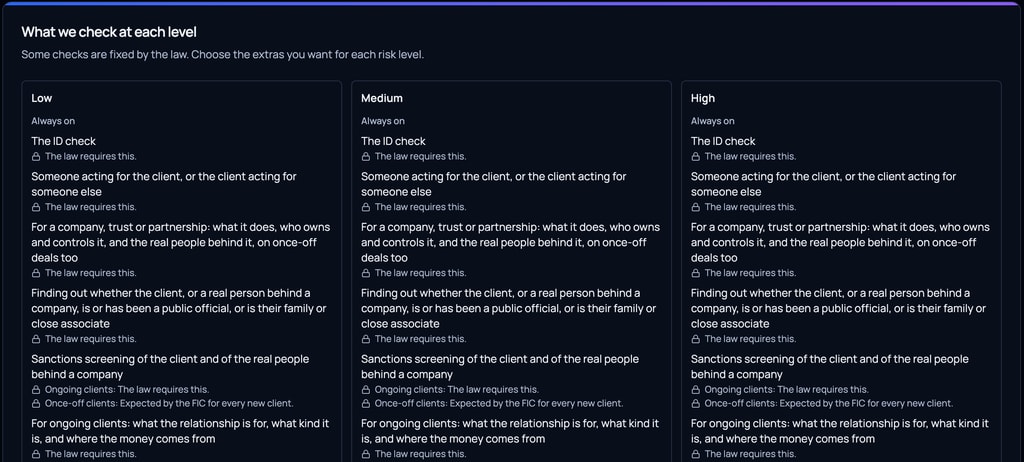
Set your risk rules once. Each client is rated, and their checks run by their risk, never below what the law asks.
- Higher risk asks for more: senior sign-off, and where the money and wealth come from.
- Reviews come round on time, sooner for higher risk.
The default requirements are a starting point informed by FICA, not legal advice. Your own Risk Management and Compliance Programme stays yours to write.


How it works
Three steps, start to finish
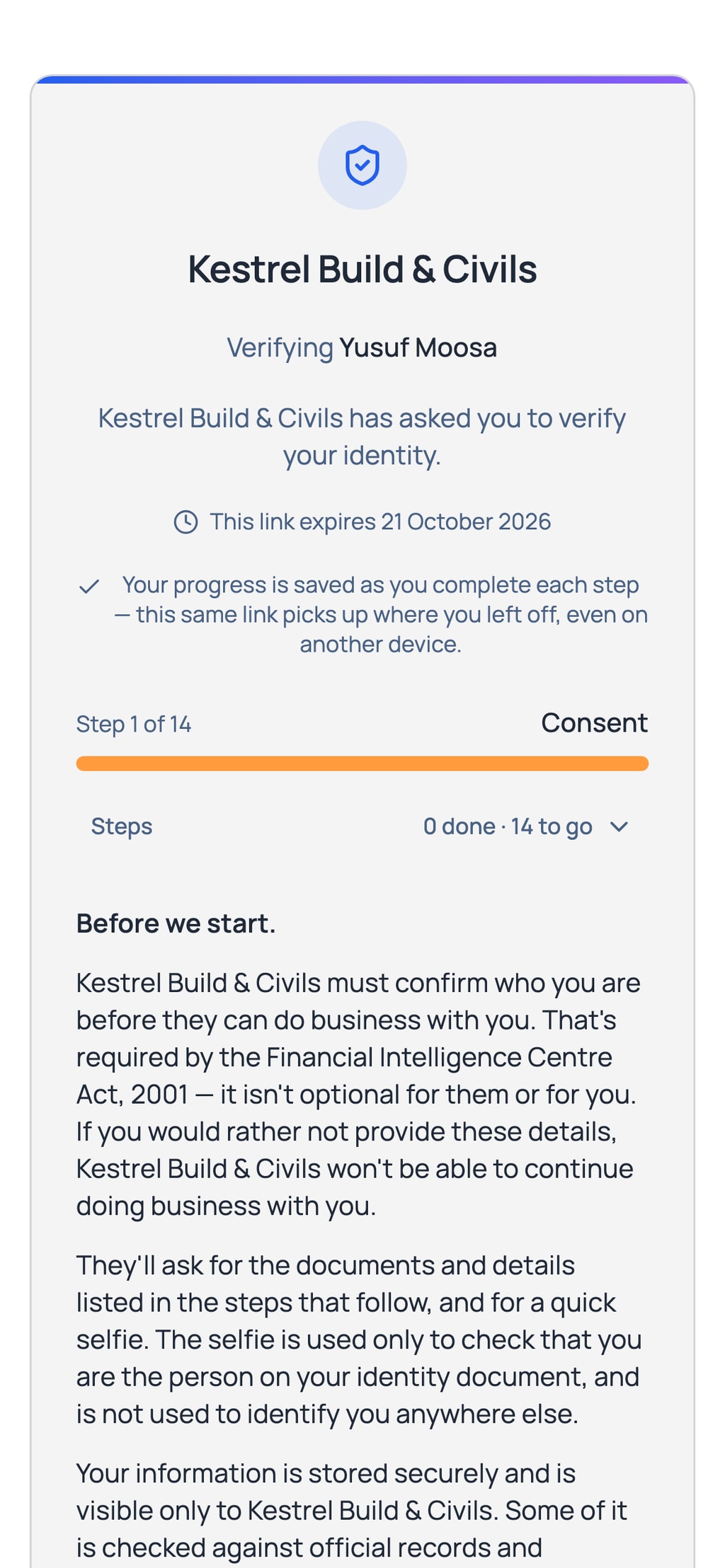
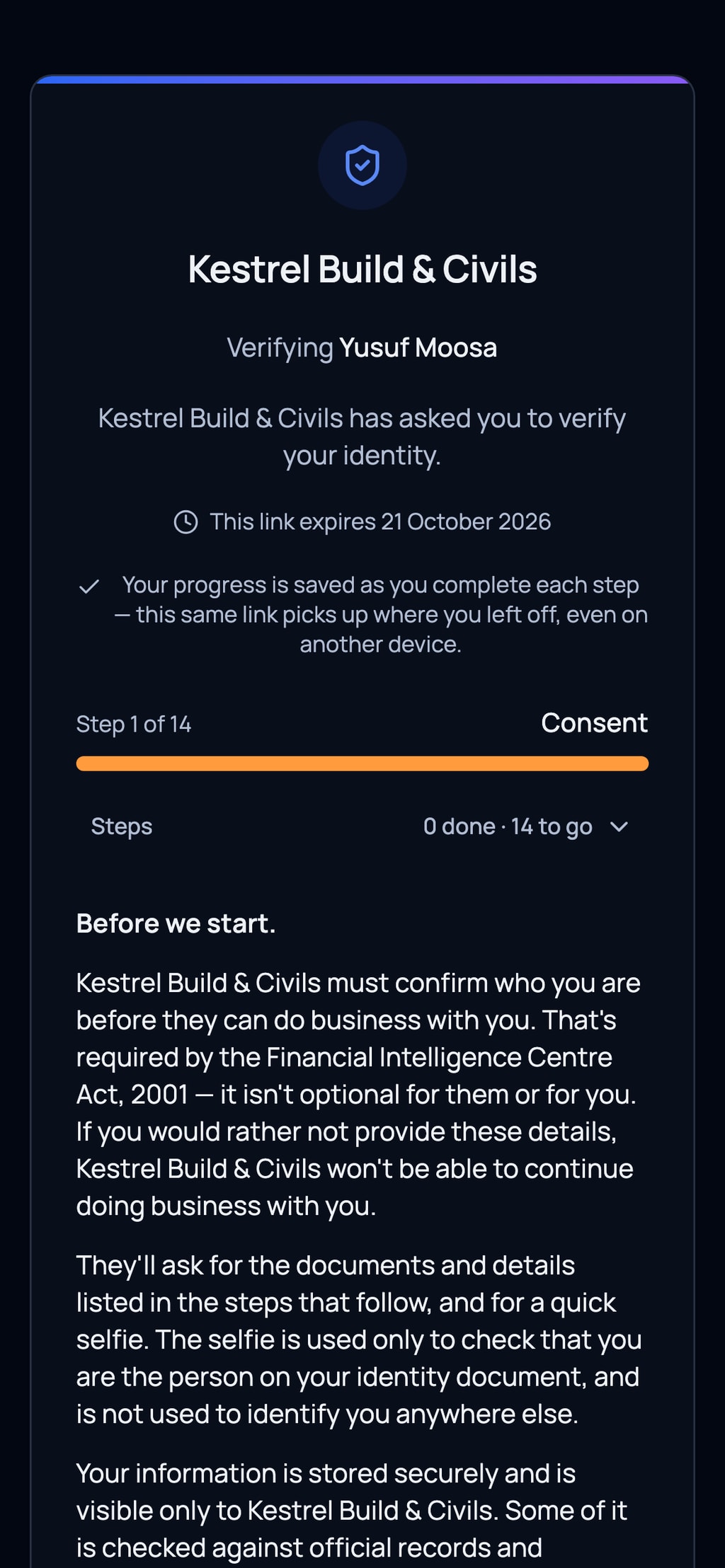
What your client sees. No app to install.
Step 1
Send the client a link. They fill in their details and upload documents, plus a selfie if you ask for one.
Step 2
When your plan calls for them, checks run, for example ID, company, bank account, sanctions and politically exposed people, and the news.
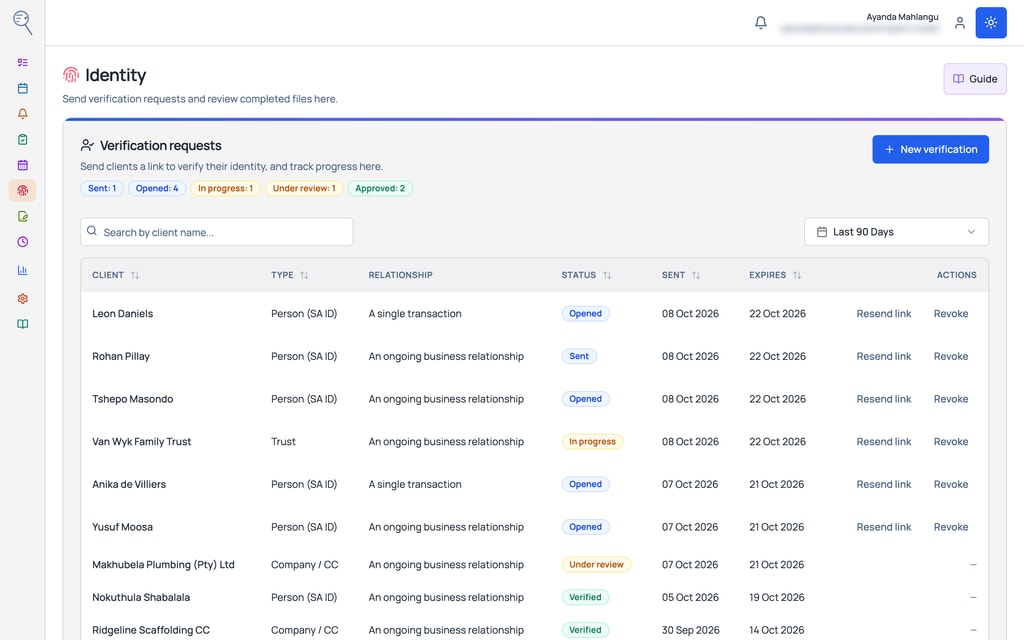
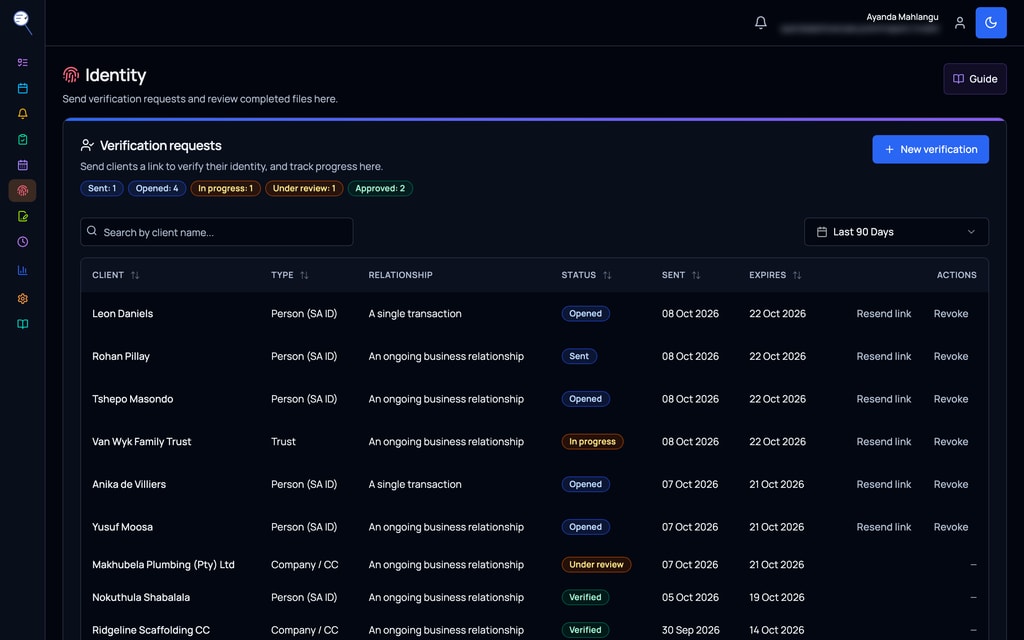
Step 3
Review the results and approve, and keep the client’s file ready for whenever the FIC asks.


What happens
From link to verified file
- Sent
- Opened
- In progress
- Submitted
- Under review
- Verified
A capture-only file’s pipeline ends at Details on file, not Verified. No checks run for it.
They do the work
A secure link by email or WhatsApp. Your client completes it on their own phone: no app, no login. On a company, trust or partnership, every party gets their own link.
Checked against the source
On the standard defaults, an SA ID is verified against Home Affairs, every person checked is screened against sanctions and PEP lists, and a company is verified against CIPC together with its directors. A partnership is not CIPC-registered, so its default is screening of its partners alongside the partnership agreement you collect. Liveness, a face match, a Home Affairs photograph comparison and document authentication can be added to any client type’s plan. This is the default plan; your firm’s administrator can tailor which checks run.
Audit-ready by default
A FICA and RICA register you can export to CSV, a compliance pack for each client, and a retention clock set to your own period, at least the five years the law requires. Records purge automatically once it expires, and cannot be deleted inside it, because destroying a record in that window is a criminal offence.
Five client types, and what runs for each
- Person (SA ID)
- On the standard defaults, an SA ID is verified against Home Affairs and the person is screened against sanctions and PEP lists. Liveness, face matching, a Home Affairs photograph comparison and document authentication can be added to the plan.
- Person (foreign passport)
- Collected, documented and screened on the standard defaults. There is no South African registry for a foreign passport, so we do not claim to verify one.
- Company / CC
- On the standard defaults, verified against CIPC together with its directors, and each director with an SA ID is verified and screened in their own right.
- Partnership
- Not CIPC-registered; the partnership agreement is collected, and each partner is verified and screened on the standard defaults.
- Trust
- Document-based, with each trustee verified and screened on the standard defaults. There is no machine-readable South African trust registry, so we do not invent one.
On the standard defaults, every party with an SA ID is verified and screened in their own right: directors, trustees, partners and beneficial owners. Beneficial ownership is the requirement agencies most often cannot evidence. That is the default plan; your firm’s administrator can tailor it per client type.
Set it up once. Auto-run does the checking.
Decide once which checks run for each client type. That configured plan is yours to set. With auto-run switched on for your company and a monthly spend cap in place, submitted files are checked automatically against your plan. Prefer to stay manual? Your staff run the same checks with one click at review.
Auto-run is switched on per company. Ask us when you want it. It only ever executes a plan your firm configured, never past the monthly cap you set, and anything that cannot complete is refunded to your balance.
What it costs
Pay only for the checks you run.
Collecting and filing a client’s documents comes with your plan. When a client needs verifying, you run the checks your plan calls for, each charged per check from your balance, and on the standard defaults every person checked is screened against sanctions and PEP lists, because that is the first thing the FIC asks for.
Priced per check, not by the number of people on your team.
Person checks
- SA ID verificationStandard default
- R 4,99
- Confirms the submitted SA ID number and details against Home Affairs’ own record.
- Foreign ID verificationStandard default for foreign-national clients
- R 24,99
- Confirms a foreign national’s identity document against the register of the country that issued it.
- Liveness
- R 3,99
- Confirms the selfie was taken live by a real person, not a photo of a photo or a video replay.
- Face match
- No charge
- Compares the selfie against the photo on the ID document they uploaded.
- Home Affairs photo match
- R 39,99
- Compares the selfie against the official Home Affairs photo on record for that ID number, not the uploaded document.
- Document authentication
- R 11,99
- Checks whether the uploaded document itself is authentic.
Screening
- AML / sanctions screeningStandard default
- R 3,99
- Screens the subject’s name against sanctions and AML watchlists.
- Adverse media screening
- R 3,99
- Screens the subject’s name against adverse media coverage.
Company & registry
- CIPC company lookupStandard default
- R 39,99
- Looks up the company’s registration details at CIPC.
- CIPC directors lookupStandard default
- R 39,99
- Looks up the company’s registered directors at CIPC.
Bank account
- Bank account verification
- R 21,49
- Confirms the submitted bank account details.
Address
- Address lookup
- R 10,99
- Scores the address on record for the ID number against the address the client gave.
Show prices in
Rows marked “Standard default” are the checks an unconfigured firm’s plan runs. Your firm’s administrator can tailor them. Everything else runs only when added to a plan or run on a specific file.
Person checks are charged per person they run on: on the standard defaults, every director, trustee or partner with an SA ID runs and pays for their own per-party checks. A trust has no registry fee, but its trustees are each checked in their own right.
The free trial never includes verification checks: they are charged per check from your prepaid balance, during a trial too. Collecting and filing documents comes with your plan.
No per-seat uplift on checks. Top up a balance, spend it on the checks you actually run, and anything that cannot complete comes straight back.
Prices exclude VAT. Verification checks are paid from a prepaid balance in rand, with a tax invoice for every top-up.
What this does, and what it does not.
- We do not submit your Risk and Compliance Return.
- The RCR is the FIC’s own questionnaire about your firm (how you understand your risk and what controls you have implemented), filed on their platform by their deadline. We give you the evidence behind your answers. A person at your firm still submits it.
- We are not your RMCP.
- The default requirements per client type are a starting point informed by FICA. You switch them on or off to match your own Risk Management and Compliance Programme. They are not legal advice and they do not replace your judgement on a particular client.
- A check is not a guarantee.
- It reports what a registry returned at that moment. It is not proof of anyone’s identity, honesty or fitness to transact, and it does not discharge your own duty to assess risk, scrutinise a transaction, or report where the law requires it.
- If a provider is down, you are not charged.
- The check does not run and the amount returns to your balance.
- Screening is checked internationally.
- The identity and company checks run against South African registries. Screening is global: sanctions and PEP screening on the standard defaults, adverse media screening when your plan calls for it, so a screen sends the person’s name, and for the sanctions and PEP screen their date of birth, to an international screening provider outside South Africa, under a written agreement requiring protection substantially similar to POPIA.
Questions
FICA verification FAQs
Are estate agents accountable institutions under FICA?
Yes. Property practitioners are accountable institutions under the Financial Intelligence Centre Act, so you must establish and verify who your clients are before acting for them, keep those records, and screen against sanctions and politically exposed person lists.
What must a FICA client file contain?
What your own Risk Management and Compliance Programme requires for that client and that risk. In practice: who the client is and how you established it, the identity documents behind that, verification of the people who control or benefit from a company, trust or partnership, evidence of the source of funds where your programme calls for it, sanctions and PEP screening results, and a record of what you decided and when.
How long must FICA records be kept?
At least five years from the end of the business relationship or the conclusion of the transaction. Destroying a record inside that window is a criminal offence, which is why records are purged automatically after the period and never inside it.
What does a verification cost?
Collecting and filing documents comes with every plan. Checks are charged per check from your prepaid balance, on top of your plan’s monthly minimum. They start from the standard defaults for each client type; that is the default plan, and your firm’s administrator can tailor which checks run.
Does the free trial cover FICA verification?
No. Verification checks are never part of the free trial: they are charged per check from your prepaid balance, during a trial as well. Collecting and filing client documents comes with your plan.
Does this replace our RMCP?
No. The module ships default document requirements per client type as a starting point informed by FICA, and you configure them to match your programme. Your RMCP remains yours to write and to maintain.
Do you submit our Risk and Compliance Return?
No. The RCR is submitted by your firm on the FIC’s own platform. What we provide is the underlying evidence: verified client files, screening results and an audit trail, so that answering it is a matter of record rather than recollection.
Does this work outside South Africa?
Not yet. The identity and company checks run against South African registries (Home Affairs and CIPC), and the module is built around FICA. Sanctions and PEP screening is international, but the verification itself is South African for now.
Know who you are dealing with, and be able to prove it.
Prefer to chat?